Smart Notes is an AI therapy notes tool built for Canadian mental health professionals. It is not a chatbot, a third-party AI tool, or a generic AI tool. It exists fully within Owl Practice’s secure environment, and data never leaves Owl Practice or gets shared with any AI system for training purposes.
Smart Notes is designed to help you create editable draft clinical notes within Owl Practice, while keeping you in charge of reviewing, editing, and approving the final record.
That distinction matters.
When clients hear “AI notes,” they may wonder whether their private session information is being shared with a third-party AI system. Before using an AI notetaker with a client, you should clearly explain what the tool does, how it works, and how it supports your therapy documentation process.
Smart Notes helps you save time on clinical documentation while keeping your workflow centred on privacy, consent, and professional judgment.
Myth: All AI Tools Work the Same Way
Not all AI tools are built for the same purpose.
Many people associate AI with public chatbots or broad large language models. That can lead clients to assume their therapy information is being sent to a third-party AI tool, reused, or used to train future AI systems.
Smart Notes is different.
It is a purpose-built documentation tool for mental health professionals. It is designed to support therapy notes, not everyday tasks. A generic AI tool is not the same as clinical documentation software built for privacy-conscious healthcare workflows.
Owl Practice does not use customer session data to train, fine-tune, or improve AI models, including third-party models. Smart Notes uses a sandboxed large language model solely to process the specific content you provide for the purpose of assisting with documentation for that session.
Session data is processed on a per-use basis and is not retained or reused for model training or learning. Customer data is not shared with external AI model providers for training purposes and is not used to develop or enhance AI systems outside of your documentation workflow.
Data continues to be handled in accordance with Owl Practice’s privacy, security, and data-retention practices. As with all documentation in Owl Practice, you remain in charge of reviewing, editing, and approving notes before they are finalized.
Takeaway: Smart Notes is not a chatbot or a generic AI tool. It is a therapy documentation tool that lives and operates fully within the confines of a secure environment designed to support your clinical workflow.
Why Generic AI Tools Are Not the Right Fit for Therapy Notes
Therapy notes contain sensitive client information. Your documentation process needs to support privacy, consent, security, and clinical responsibility from start to finish.
AI chatbots like ChatGPT, Claude, etc. are not designed for confidential clinical documentation. They may not support healthcare-specific privacy needs, client consent workflows, or structured therapy note formats. They may also require you to copy session information into a separate platform, which creates unnecessary risk.
For therapy documentation, you need tools that fit the way you already work. That includes creating notes, reviewing clinical details, editing for accuracy, and finalizing the record with your own professional judgment.
AI should reduce the administrative burden of writing notes. It should not replace your role as a clinician.
Smart Notes helps create a draft note, but you decide what belongs in the final clinical record. You review the content. You make edits. You approve the final note.
Takeaway: Generic AI tools are not designed for therapy notes. Purpose-built clinical documentation software gives you more control over privacy, consent, and note review.
What Makes Smart Notes Different?
Smart Notes is built specifically for Canadian mental health professionals who want support with AI therapy notes and clinical documentation.
It is built in Canada and works within Owl Practice’s secure, PIPEDA-compliant environment. Recordings, transcripts, and notes stay within the Owl platform, so you do not need to move sensitive session information into a separate generic AI tool.
Smart Notes supports multiple documentation workflows. You can use it with Owl Practice Telehealth or uploaded media files. You can also use it for in-person sessions, telehealth appointments, dictation after a session, couples therapy, and supervised sessions.
For sessions with more than one participant, Smart Notes can assign speakers. This helps make the draft note easier to review and edit.
Smart Notes can generate structured draft notes using SOAP, DAP, or Session Summary templates. These templates give you a helpful starting point while still allowing you to shape the note using your clinical judgment.
It also supports client consent through secure consent forms in the Client Portal. That makes it easier to explain your process clearly and document consent before using the tool.
Takeaway: Smart Notes is built to fit therapy documentation workflows, not replace them. You stay in control of every final note.
How Is Smart Notes Different from Generic AI Tools?
Here is a simple way to compare generic AI tools with Owl Practice Smart Notes:
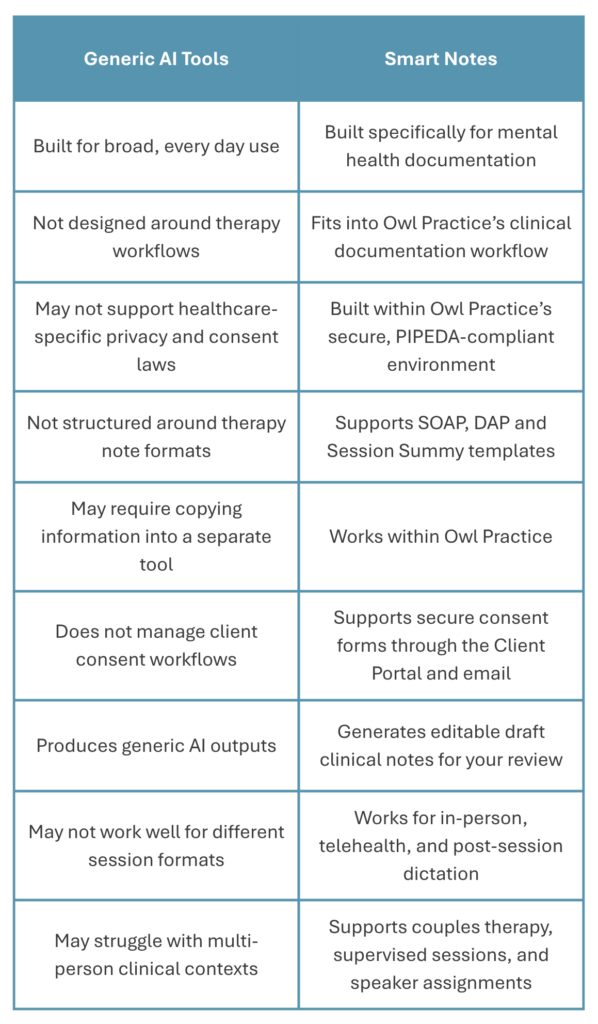
This comparison can help clients understand what “AI notes” means in your practice. Smart Notes is not a separate public chatbot. It is part of your Owl Practice documentation workflow.
That difference is important for trust. When you can explain the tool clearly, clients are more likely to feel informed, respected, and comfortable asking questions.
Takeaway: Smart Notes creates editable draft clinical notes inside Owl Practice, while you remain responsible for the final record.
What Should Clients Know About Smart Notes?
Before using Smart Notes with a client, you should explain what it does in clear, plain language.
You might say:
“Smart Notes is a documentation tool built into Owl Practice. With your consent, it helps create a draft note from our session so I can spend less time on documentation and more time focused on your care. It is not a public AI chatbot. The recording, transcript, and note stay within the secure Owl Practice platform. The recording is deleted after the transcript is created, and your session information is not used to train a large language model. I will review, edit, and approve the final note myself.”
This explanation answers the questions clients are most likely to ask:
What is Smart Notes?
It is an AI documentation tool built into Owl Practice.
Is Smart Notes a public AI chatbot?
No. It is part of your clinical documentation workflow.
Who approves the final therapy note?
You do. The therapist remains responsible for the final clinical record.
Is client consent required?
You should discuss consent before using Smart Notes and document it through your workflow.
Takeaway: Clear client communication helps protect trust. Explain how Smart Notes works, how it differs from generic AI tools, and how you remain responsible for the final note.
Conclusion: Not All AI Tools Are the Same
Not all AI tools are designed for therapy. Generic AI tools and AI therapy documentation tools serve very different purposes.
Smart Notes is built specifically for Canadian mental health professionals. It supports secure workflows, client consent, structured clinical notes, and therapist review before anything is finalized.
Used thoughtfully, Smart Notes can help you save time on documentation while maintaining control over the clinical record. The goal is simple: support your work, reduce administrative load, and help you spend more time focused on client care.
Owl Practice’s Smart Notes automate your note taking using privacy compliant AI, so you can spend more time with clients and less time on paperwork. Learn more about Smart Notes.