Therapy notes carry meaning beyond words on a page. They hold someone’s story, their progress, and the moments where breakthroughs begin. Mental health professionals understand this deeply, yet documentation can feel like an invisible second workload that never fully comes to an end. Writing notes while staying compliant, secure, organized, and thorough requires emotional energy, time, and confidence in how information is stored and protected.
When note-taking systems feel uncertain, many therapists carry worry in the background of their practice. Below, we explore what you need to know about compliance and security in therapy note-taking in Canada, allowing you to focus more on clients and less on administrative tasks.
Understanding Canada’s Therapy Notes Compliance Requirements
Canadian therapists need to follow federal privacy law, provincial legislation, and the documentation expectations set by their professional colleges. When all three align, notes remain secure and adequately maintained.
Federal and Provincial Privacy Legislation
The Personal Information Protection and Electronic Documents Act (PIPEDA) is the federal law governing how private sector organizations collect, store, and use personal information. Many provinces also have their own health-specific privacy laws that meet or exceed federal expectations.
Below are common Canadian frameworks therapists work under:
- PHIPA in Ontario: A privacy law that protects personal health information within the province. It outlines the requirements for collecting, storing, sharing, and retaining clinical information.
- Personal Information Protection Act (PIPA) in British Columbia: Governs private organizations and gives individuals rights to access and correct personal information.
- PIPA in Alberta: Similar to British Columbia’s version, with several provisions focused on consent, protecting data, and retention timelines.
These laws share a common goal, which is ensuring that client information is handled responsibly at every stage of storage and communication.
The Role of Your Professional College
Legal compliance is only one side of documentation. Every therapist belongs to a professional body that outlines expectations for record-keeping and documentation. This may include college governing bodies, such as those made up of psychotherapists, psychologists, clinical social workers, or counsellors. Each college sets its own requirements for what must be included in clinical records, how long they must be kept, and how they should be secured.
Following regulatory standards is part of ethical practice. It supports continuity of care, helps protect you in the event of audits or complaints, and ensures that notes remain clear and usable if another clinician needs to review them. When documentation is done thoughtfully, it becomes a tool that strengthens the therapeutic process.
Secure Note-Taking for Therapists
Compliant note-taking in therapy is clear, factual, clinically appropriate, and valuable for continuity of care.
Essential Information to Remain Compliant With Your Note-Taking
Including the following core elements can help ensure that notes remain complete and legally sound:
- Client name and unique identifier: Ensures correct file tracking.
- Date, start time, and duration of session: Establishes when care was delivered and for how long.
- Confirmation of informed consent: Notes if consent was reviewed or updated.
- Session focus and interventions used: Describes what was explored and which techniques were applied.
- Client response: Reflects engagement, emotional reactions, or shifts observed in the session.
- Therapist’s assessment: Summarizes professional interpretation and clinical impressions.
- Treatment plan updates: Track goals, progress, or changes in direction.
- Communication with third parties: Records any coordination with other providers involved in care.
What to Exclude to Minimize Risk
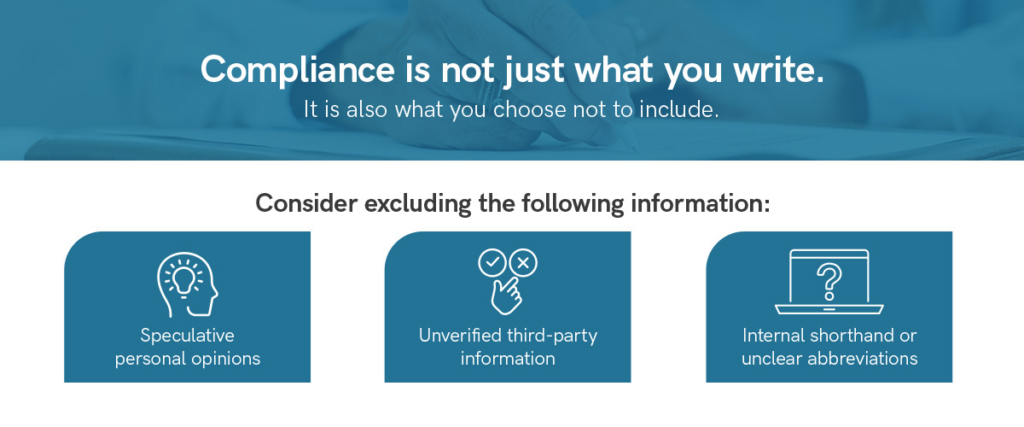
Compliance is not just what you write. It is also what you choose not to include. Over-documenting can create vulnerability if sensitive or subjective information is recorded without purpose.
Consider excluding the following information:
- Speculative personal opinions: Only document information supported by observation or fact.
- Unverified third-party information: Record it separately with caution if required for care planning.
- Internal shorthand or unclear abbreviations: Another clinician must be able to read notes clearly.
The goal is to record relevant information while maintaining a secure, factual, and respectful approach to client privacy.
The Risks of Outdated Note-Taking Methods
Paper notes can be physically lost, damaged by fire or water, or accessed without permission. Computer files stored locally can be exposed through viruses, stolen hardware, or unsecured Wi-Fi. A misplaced laptop or unlocked filing cabinet has the potential to compromise years of client work.
Digital note-taking built specifically for mental health professionals removes much of this risk. It creates a consistent framework for security, storage, and access control, allowing therapists to document with ease and confidence.
Choosing Compliant Therapy Note-Taking Software
When it comes to selecting digital tools, there are many options on the market nowadays. The goal is not to compare long feature lists, but instead to find a solution that supports ethical care and reduces the administrative weight of documentation. Software should feel like a supportive partner, rather than an additional burden.
Secure Documentation for Mental Health Practices Checklist
The following is a practical evaluation list for selecting compliant therapy note-taking software:
- PHIPA and provincial compliance: The provider should confirm adherence to Canadian privacy law.
- Canadian server storage: Data should be stored locally rather than internationally.
- Bank-level encryption: Ensures records are protected digitally at all times.
- Role-based permissions: Allow different access levels for administrative staff or team members.
- Secure client portal for communication and documentation: Useful if clients require form sharing or session preparation materials.
- Automatic backups: Protect against data loss with minimal manual effort.
Frequently Asked Questions
Get your pressing questions on therapy note-taking answered.
1. Are Digital Notes Legally Valid?
Digital notes are valid when stored correctly, securely, and with compliant encryption. Mental health practice management platforms built for therapy documentation are designed with this in mind.
2. Can I Keep Process Notes Separate From Clinical Notes?
Yes. Many mental health professionals maintain private process reflections for personal clinical thinking. These need to be stored securely, separate from the formal record.
3. Is Email a Secure Way to Send Client Documents?
Standard email is not PHIPA-compliant for the handling of personal health information. Secure platforms or encrypted communication tools should be used instead.
Simplify Compliance and Security With Owl Practice
Therapy is intimate work. Behind every note is a story that someone trusted you to hold carefully. Understanding Canadian legislation and creating secure documentation practices is part of that responsibility, yet managing compliance alone may seem daunting. Digital notebooks, folders, or paper binders may not always be sufficient to meet privacy obligations or protect the progress clients make with you.
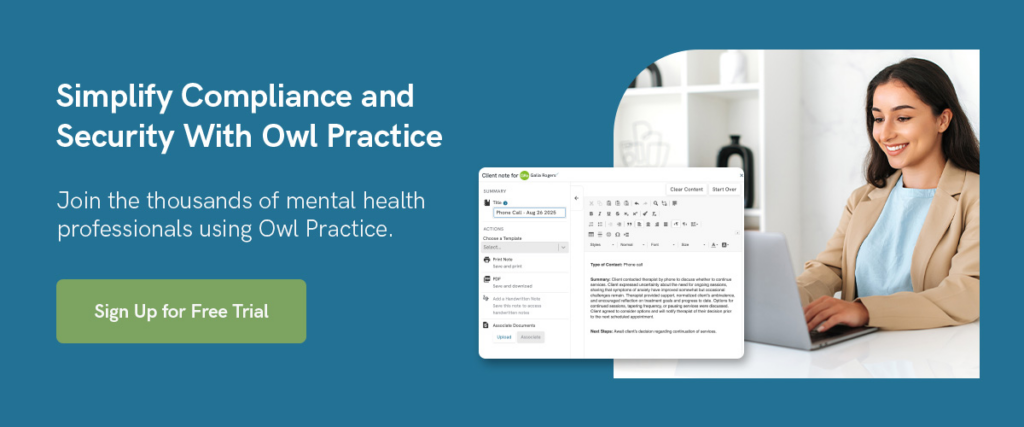
Owl Practice was created in Canada for mental health professionals who want confidence in how their records are managed. The Enhanced Session Notes feature supports secure documentation that aligns with Canadian privacy requirements, including PHIPA, while keeping client information stored within Canada. It is one safe space to document work, attach files, tag information for easy retrieval, and maintain a structure that supports continuity of care.
Sign up for a free trial and join the thousands of mental health professionals using Owl Practice to stay compliant, secure, and manage therapy documentation.