Running a therapy practice in Canada comes with responsibilities that extend beyond client care. Taxes are one of them. While most therapists understand that taxes need attention, they may feel unclear about what they need to track, what they can claim, and how recent rule changes apply to their work.
For many therapists, tax season becomes stressful because it feels uncertain. Without a clear approach, it is easy to second-guess decisions or worry about missing something important.
This comprehensive guide explains tax planning for Canadian therapists, helping you understand what matters and stay organized throughout the year without adding extra complexity to your work.
What Tax Planning for Therapists in Canada Actually Involves
Tax planning does not require advanced financial knowledge. For most therapists, it means understanding a few core ideas and applying them consistently.
At a practical level, tax planning involves:
- Knowing what income from your practice you must report.
- Understanding which expenses relate directly to your work.
- Keeping records that are clear and easy to review.
- Staying aware of filing and payment deadlines.
The 2024 GST and HST Change for Psychotherapists and Counsellors
In 2024, the Canada Revenue Agency (CRA) clarified how Goods and Services Tax (GST) and Harmonized Sales Tax (HST) apply to certain psychotherapy and counselling services. As of June 20, 2024, some psychotherapy and counselling therapy services are exempt from GST and HST. This change affects how some therapists invoice clients and whether they should still charge GST or HST. Since this update affects billing and tax registration, it is essential to understand how it applies to your specific situation.
Who the GST and HST Change May Apply To
The exemption does not apply automatically to everyone in mental health. Eligibility depends on factors such as your professional designation, the services you provide, and the regulatory framework in your province.
For example, regulated psychotherapists, psychologists, and certain counsellors may qualify when providing eligible therapy services. In some cases, unregulated practitioners may also qualify if they meet specific educational requirements.
Reviewing CRA guidance or checking with an accountant can help ensure your invoices reflect the correct tax treatment.
What to Do if You Were Already Charging GST and HST
If you were already registered for GST and HST and charging them to clients, the change may require a few steps. The goal is to make sure your invoicing and records reflect your current obligations.
The following steps may be involved:
- Review whether your services are now exempt: Confirm that the services you provide fall under the CRA exemption.
- Update how you invoice clients: Remove GST and HST from invoices for services that are exempt.
- Assess whether you still need a GST and HST account: Determine whether your registration should be updated or closed.
- Align your records: Ensure your invoices, filings, and bookkeeping all follow the same approach.
Private Practice Therapist Taxes and Your Business Structure
Your business structure affects how you report income and how complex tax filing feels.
Many therapists may operate as sole proprietors, especially in solo practice or early in their careers. However, you may also form a partnership with one or more people or create a corporation.
Sole proprietorships and partnerships offer no separation between you and your business, so you only file a personal tax return. A corporation creates a business entity that is legally separate from you as a person, which protects your individual assets but requires you to file business taxes separately.
How to File Taxes as a Therapist in Canada
Most therapists in private practice are self-employed as sole proprietors, which affects how they file their taxes.
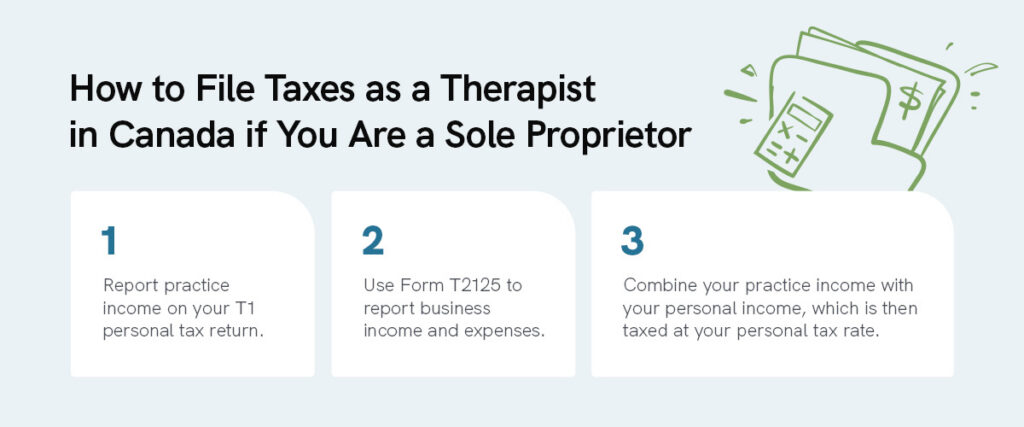
If you are a sole proprietor:
- Report practice income on your T1 personal tax return.
- Use Form T2125 to report business income and expenses.
- Your practice income is combined with your personal income and taxed at your personal tax rate.
Key dates to remember:
- April 30: Deadline to pay any taxes owing.
- June 15: Filing deadline for self-employed individuals.
Before filing, it helps to gather income totals, expense records, GST and HST information if applicable, and your previous year’s return for reference.
Therapist Tax Deductions in Canada Explained Clearly
Understanding self-employed therapists’ tax deductions helps reduce uncertainty at tax time. Deductions lower the income you are taxed on, but they must be reasonable, connected to your practice, and supported by records.
Professional Fees and Licensing Costs
These expenses relate directly to your ability to practice. Common examples include regulatory college fees, professional association memberships, and accounting or bookkeeping services used for your practice.
Clinical Supervision and Continuing Education
Professional development is part of ethical practice and often a necessary expense.
Examples include clinical supervision, continuing education courses, and training events that support your current work. A course directly related to trauma care or assessment methods is easier to support than a general wellness retreat.
Office, Rent, and Home Office Expenses
If you rent office space outside your home, rent and related costs are usually straightforward to track.
If you work from home, you may be able to claim a portion of household expenses based on the space used for your practice. For example, using one room exclusively for work may allow you to claim a percentage of eligible expenses. The key is to use a reasonable method and apply it consistently.
Software and Digital Tools Used in Your Practice
Digital tools are easy to overlook because they are often billed monthly. Common examples include practice management software, accounting software, video platforms, and website hosting. Reviewing bank statements regularly helps ensure you don’t miss these expenses.
Can Therapists Claim Personal Development Courses on Taxes?
In general, expenses are easier to support when they clearly relate to professional skill development. Courses that are primarily personal in nature are more challenging to justify as business expenses. If a course sits in a gray area, keep documentation and discuss it with your accountant before claiming it.
Simple Habits That Make Tax Season Easier
These therapy practice tax tips focus on habits that make tax season easier without adding extra work. Keeping business and personal finances separate helps clarify expenses. Setting aside money for taxes as income comes in reduces surprises. Monthly check-ins help keep information current.
Together, these habits help maximize tax efficiency in therapy by spreading admin tasks throughout the year rather than letting them pile up.
Common CRA Issues Therapists Can Avoid
Most CRA issues arise from unclear records rather than intentional mistakes. Common problems include overstated deductions, mixed personal and business expenses, and missing documentation. Clear records and reasonable claims are usually enough to avoid issues.
Make Tax Season More Manageable
Tax planning does not need to feel overwhelming. With a few steady systems in place, tax season becomes predictable and easier to manage.
Owl Practice offers a solution designed to simplify your practice management and keep everything, including your invoicing, payments, and reporting, organized. We work with practitioners across Canada who are building exceptional practices, and we’re here to support your growth. Sign up for a free trial today and let us help you manage your tax season.